
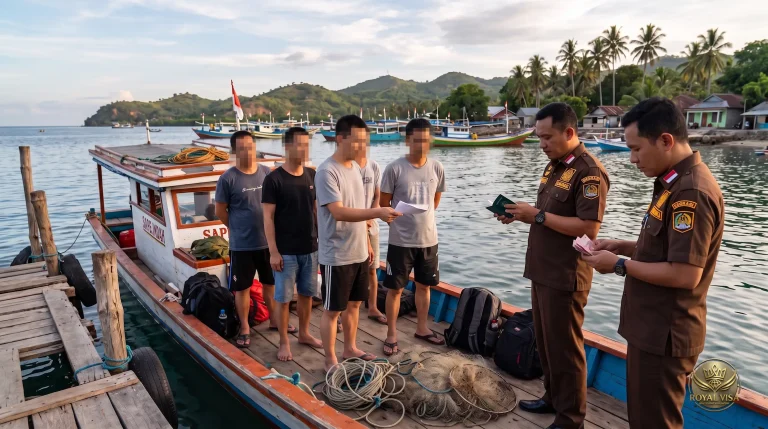
A visa can answer one question and leave several others open. That distinction sits at the centre of a case reported by the Directorate General of Immigration in Atambua in September 2026.
According to the official release, Atambua Immigration deported five male Chinese nationals through Soekarno-Hatta International Airport on 25 August 2026. Immigration said it suspected that the men intended to use Indonesia as an irregular transit route to Australia. That was the agency’s stated suspicion in this particular examination. It was not presented as a new rule for every visitor.
The release also says the five had entered through Batam using visa on arrival and visit visas. It is easy to take that detail and somehow announce a nationwide VoA policy before lunch. The source does no such thing.
It describes statements and circumstances that officers considered inconsistent. The case tells us what Immigration reported, what raised concern in one examination, and what happened to the five people. It does not settle wider questions about visa on arrival in Indonesia, routes, activities, or future outcomes.
What Immigration reported in Atambua
The official account begins in Atapupu, Belu. The release says officers found the five foreign nationals there on 18 August 2026 after receiving an initial report from Atapupu port authority officers about a passenger vessel suspected of carrying foreign nationals.
During the examination, according to the release, the men said they planned to fish around Lirang in Maluku. The head of Atambua Immigration, Jusuf Ginting, said the fishing equipment they carried did not meet the specifications ordinarily used for activity at sea.
That was one part of the account. Immigration also described other details that officers considered relevant: the funds the men carried, whether their names appeared on the speedboat’s official passenger list, and the difference between the route stated in the vessel’s sailing document and the place where the vessel was detected.
The release says the men carried about Rp4 million. Ginting described that amount as generally insufficient to cover a long-distance speedboat operation from Lombok to Maluku. It also says the men were not recorded on the official passenger list for the speedboat they were travelling on.
The vessel’s sailing document, as described in the release, showed a planned journey from Lombok to Sape Island. The release then says the vessel was detected in Atapupu without valid sailing permission for that route.
These details belong to this case. They should not be rearranged into a universal legal test. The release does not say that one amount of cash proves an intention, that every fishing plan requires the same equipment, or that a homemade checklist can decide someone’s immigration position.
It says officers considered several circumstances together and found that they conflicted with the initial explanation. Immigration then said it suspected the five men intended to use Indonesian territory as an irregular transit route to Australia.
“Suspected” matters. The release reports Immigration’s assessment; it does not turn the allegation into a fact proven for every purpose.
The reported examination
What stands out is not one isolated detail. It is the mismatch described by Immigration between the stated purpose and the surrounding circumstances.
The men reportedly said they were going fishing near Lirang. Officers then considered the equipment, funds, passenger-list information, and vessel-route information. Immigration’s account presents those points as the basis for its concern and later suspicion.
That is as far as the evidence allows us to go. The source does not publish an official checklist for travellers. It does not tell readers which single answer, document, item of equipment, or amount of money would have changed the assessment. It certainly does not guarantee that a neat folder and a confident smile will resolve every question. Bureaucracy has never been that fond of theatre.
For readers, the sensible lesson is narrower. Information given about a trip should be truthful and should match the actual arrangements. If the stated purpose points one way while several surrounding details point another, officers may ask questions. In this reported case, Immigration said those contradictions contributed to its suspicion.
The reported outcome
The release says the five men entered Indonesia through Batam on 31 July 2026 using visa on arrival and visit visas. Atambua Immigration later deported them through Soekarno-Hatta International Airport on 25 August 2026.
Immigration also reported placing all five on its cekal list, the Indonesian term used in the release for the prevention and deterrence list. Those are the outcomes stated for the individuals in this case.
They should remain case facts, not predictions. The release does not establish that another traveller with a confusing itinerary will be deported, placed on the same list, refused entry, or treated in any particular way. It gives no standard result that can be applied to someone else’s circumstances.
A press release about five people can tell us what the agency says happened to those five people. It cannot write the ending to the next person’s case.
The point is not “VoA is banned”
The five men’s entry documents appear in the release because they are part of the reported chronology. The source says they entered through Batam using visa on arrival and visit visas. It does not say those visa categories were abolished, suspended, narrowed by a new rule, or made subject to a newly announced transit policy.
Nor does the release announce that VoA holders are universally forbidden from domestic travel, coastal travel, fishing, or following a particular route. It does not decide which routes are lawful or unlawful for every visitor. Those questions sit outside the evidence approved for this article.
This is where reading discipline matters. A person’s visa status and the account they give officers appear in the same case, but that does not make every issue identical. The release identifies the documents used and then describes circumstances that Immigration considered inconsistent with the men’s explanation.
The official release is equally silent on general VoA validity, extensions, eligibility, or permitted activities. Adding those facts from memory would create a different article. The internet already has enough confident paragraphs built from three unrelated facts and a strong cup of coffee.
The Atambua release reports one enforcement case. It does not announce a new VoA rule, transit policy, universal restriction, illegal-route map, or uniform outcome for other travellers.
Why consistent, truthful travel details matter
Immigration’s release describes an examination in which officers compared what the men said with several surrounding facts. The agency said the details did not align and that this led to suspicion about a different intended purpose.
That makes accuracy more than a matter of getting dates into the correct boxes. Your stated purpose should describe your actual purpose. The arrangements you explain should be the arrangements you genuinely have. If a plan changes, the account of that plan should not remain stuck in an earlier, more convenient version.
This is practical advice, not an official test. The release prescribes no script, says nothing about sufficient evidence, and does not promise that a truthful explanation guarantees entry, stay, approval, or another result.
A traveller can control whether their own account is honest. That sounds obvious until someone else made the booking, transport details are vague, and everyone describes the plan differently. Complicated plans get worse when nobody can explain them clearly.
A case is not a template for every traveller
The reported factors should not be copied into a scorecard. Four million rupiah is a fact stated in this release, not a universal financial threshold. Fishing equipment was part of this examination, not a general immigration standard created by the article. Passenger and sailing information concerned the vessel described in the case, not every form of onward movement in Indonesia.
The same care applies to Immigration’s suspicion about irregular transit to Australia. That suspicion was attributed to the examination described by the agency. It does not prove that any particular place, journey, or sea route is inherently unlawful for all travellers.
When a case attracts attention, people often want a short rule that explains everything. “Never do X” travels faster than “the source describes several facts and leaves important legal questions unanswered.” The second sentence is less exciting. It is also the one supported here.
A valid entry document should not be treated as a blank cheque that makes inconsistent information irrelevant. At the same time, this release does not establish that every inconsistency has the same meaning or consequence. Both points can be true without stretching the evidence.
Questions to clarify before travel
Before an unusual trip, ask yourself a few plain questions. Is the purpose you plan to state accurate? Do the arrangements you describe match what has actually been booked or organised? If another person arranged the transport, can you truthfully explain what you understand the plan to be?
Also check whether different parts of your own story contradict each other. That is not an invitation to rehearse a better performance. It is an invitation to find out what the real plan is before you travel.
These personal accuracy checks are not an official Immigration checklist and carry no promise about an officer’s decision. Nor do they answer which visa, activity, route, or supporting material suits a different case.
If you cannot explain an unusual arrangement without guessing, get the facts from the people involved. If the immigration implications are unclear, seek advice on your circumstances rather than treating this release as case-specific guidance.
What this case does not answer
The most responsible use of a narrow source is to say where it stops. This release does not provide general answers about who is eligible for visa on arrival or a visit visa. It does not set out permitted activities, extension rules, application procedures, fees, or length of stay.
It does not announce a rule for domestic or coastal movement. It does not determine whether fishing is permitted for every visitor or under every set of circumstances. It does not publish a list of lawful and unlawful sea routes, and this article will not invent one.
The release also does not establish a standard decision for inconsistent travel details. It reports deportation and cekal listing for five named-by-initial individuals, but it does not say that another person will receive the same outcome. There is no basis here for predicting entry decisions, boarding decisions, approvals, refusals, extensions, or ban periods.
These omissions define the article’s limits. The source is a press release about one case, not a regulation, visa product page, court finding, or general transit policy.
For broader Bali enforcement context, Royal Visa has separate coverage. That page is context, not legal authority for the Atambua facts.
There is no safe basis for saying the five men were proven to be travelling illegally in every legal sense. Immigration said it suspected an intention to use Indonesia as an irregular transit route to Australia. Preserving that wording separates an agency allegation from a broader conclusion the source did not establish.
If you arrived looking for a universal VoA warning, this case will not provide one. If you wanted a definitive ruling on a route or activity, it will not provide that either. What it provides is a concrete example of Immigration reporting that statements, documents, and surrounding circumstances did not add up during one examination.
If your plans are unusual, get the facts straight first
Unusual travel is not automatically explained by a visa label. It may involve a vessel, several islands, arrangements made by other people, or a purpose that sounds simple until someone asks for the details.
The Atambua release shows how Immigration described one such examination. Officers looked at the stated fishing purpose alongside the equipment, available funds, passenger-list status, and vessel-route information. Immigration said the contradictions led it to suspect an irregular onward intention. The reported result was deportation and cekal listing for the five people involved.
Those facts are not a guaranteed formula. Matching details do not promise approval or entry, and a mistake does not let this article predict deportation. A route or activity does not become lawful or unlawful because it resembles one detail in the release.
Understand your own plan. Do not borrow an explanation because it sounds easier or rely on a visa name to answer every question. Someone may compare the explanation with the arrangements.
If your circumstances are unusual, case-specific advice beats internet folklore. Royal Visa can help review the immigration side of a proposed trip and identify questions that need reliable answers. That offers no promise of approval, entry, boarding, timing, or outcome.
Paperwork likes consistency. Travellers need to know what they are doing and describe it truthfully. In this case, Immigration reported that the details pointed away from the initial explanation. Anything broader needs different evidence.
Source note
This article is based solely on a Directorate General of Immigration press release dated 1 September 2026 and checked live on 16 September 2026 WITA. The release reports Atambua Immigration’s account of one examination involving five Chinese nationals, the agency’s stated suspicion, and the actions it said it took. It is not a regulation or a general visa policy. The case therefore cannot establish universal rules about visa on arrival, visit visas, activities, routes, eligibility, or outcomes for other travellers. The official release is listed below so readers can review the original Indonesian account directly.


